
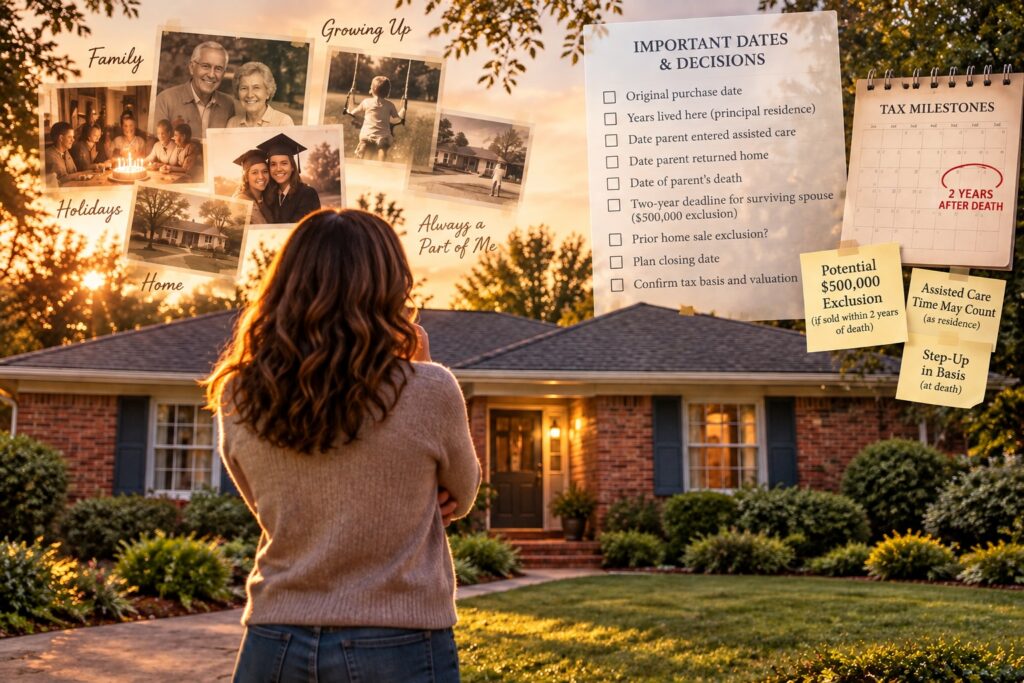
There are 4 Milestones in this process to be aware of:
- Both married spouses are alive and just downsizing to a new primary residence
- One spouse passes away and the other remains in the house
- The surviving spouse needs to move into assisted care
- The surviving spouse passes away
Both married spouses are alive and just downsizing to a new primary residence
The key tax question here (during the sale of their current home) is “Was this property your principle residence for 2 out of the last 5 years”? At stake is a $250,000 exemption for each owner; $500,000 if its a couple filing jointly for taxes.
One spouse passes away and the other remains in the house
The date of death for the spouse who passes away starts a two (2) year clock for being able to still qualify for the $500,000 combined exemption. The sale has to be completed and closed during that time period. There is also a “step up” in value upon death for the half owned by the spouse who passed away.
The surviving spouse needs to move into assisted care
Everyone’s goal is to live independently for as long as possible but eventually the day comes when we have to make a change. If the change is to assisted care, the house can usually remain the principle residence as long as something else is not purchased. But this is where the type of facility really matters AND the “2 out of the last 5 years” rule comes into play. This is a conversation you need to have with your Accountant to make sure you are aware of the timing if a sale is needed before death for living expenses.
Surviving spouse passes away
House is handled per the Last Will and Testament and/or Probate Court. Ownership is conveyed to the heir(s). An appraisal will be done to establish current value.
At the federal level, if the parent’s taxable estate plus relevant prior taxable gifts is below the applicable exclusion, there generally isn’t federal estate tax simply because the children inherit the house. For a person dying in 2026, the basic exclusion is $15 million. (IRS Estate Taxes)
That $15 million isn’t a permanent number I’d use for planning someone’s death many years from now. It is the 2026 amount, and future amounts can change with inflation and legislation.
Checklist
If you are helping your aging parents, I would be aware of some key milestones regarding taxes when it comes time to sell their home when they no longer need it. The critical federal rule is IRC §121: normally 2 years of ownership and use within the 5 years ending on the sale date, with special rules for a surviving spouse and qualifying care-facility residence. (IRS)
| ☐ | Date to establish | Regulatory significance |
|---|---|---|
| ☐ | Original home purchase date | Establishes the ownership period and helps establish original tax basis. |
| ☐ | Date each spouse began using the property as principal residence | Normally each spouse needs 24 months of residence during the 5 years ending on the sale for the married $500,000 exclusion. The 24 months don’t have to be consecutive. (IRS) |
| ☐ | Date one or both entered assisted care | Establishes the beginning of their absence from the home. |
| ☐ | Date someone became incapable of self-care | Important because the special care-facility rule applies when the taxpayer became physically or mentally incapable of self-care. (IRS) |
| ☐ | Dates the assisted-care facility was licensed | If they had at least 12 months of actual principal-residence use during the 5-year period, time in a properly licensed care facility can count toward their 2-year residence requirement. (IRS) |
| ☐ | Date someone moved back into the house (if they did) | Establishes when actual physical residence resumed. This is particularly helpful evidence that the home remained/re-became their principal residence. |
| ☐ | Exact date of first spouse’s death | Major milestone. Starts the special surviving-spouse two-year §121 window and establishes the valuation date for determining the basis adjustment associated with their interest in the property. |
| ☐ | Fair-market value as of date of death | Not a deadline, but a critical valuation date. A CPA/estate attorney should determine the surviving spouse’s adjusted basis using the applicable basis-at-death rules. |
| ☐ | Date of any previous home sale on which either spouse claimed §121 | §121 generally cannot be used if the taxpayer used the exclusion on another sale during the preceding 2 years. |
| ☐ | Two-year anniversary of first spouse’s death | Most important prospective deadline. If the surviving spouse otherwise qualifies and has not remarried, a sale not later than two years after their death can potentially receive the special $500,000 exclusion. |
| ☐ | Projected closing/title-transfer date | This is the date I’d manage against the two-year deadline—not the listing date or contract date. Build in plenty of closing cushion. |
Disclaimer
I am not a CPA nor a tax or financial advisor. Please consult a qualified professional as you navigate these rules to confirm the §121 eligibility and basis calculation — the real-estate timeline can then be built around that determination.